
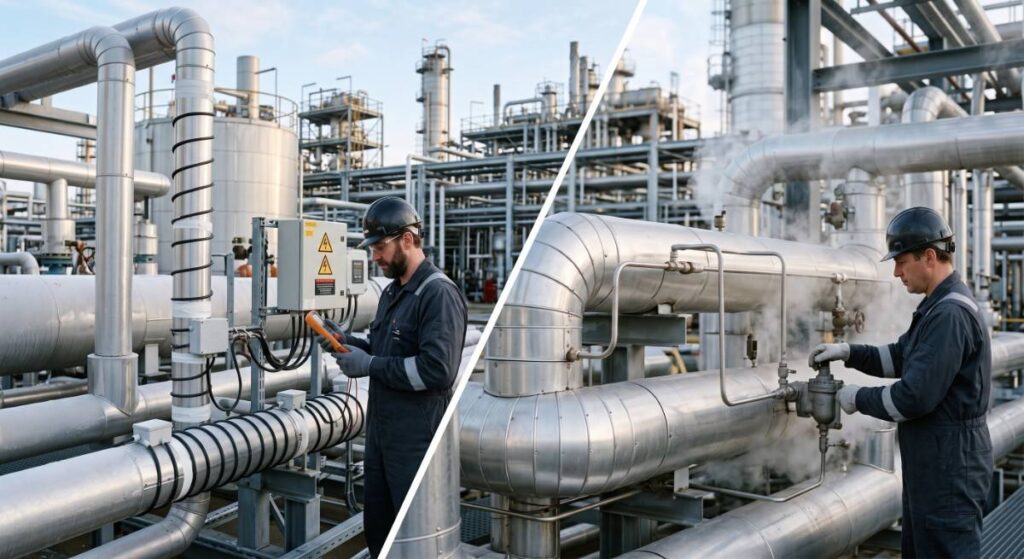
When industries operate in cold environments or require precise process temperature maintenance, choosing the right heat tracing technology becomes essential. Whether it is preventing frozen pipelines, maintaining fluid viscosity, or ensuring uninterrupted production, selecting the right solution directly affects efficiency, operating costs, and equipment reliability.
For decades, steam tracing has been the traditional method for industrial temperature maintenance. However, technological advancements have made electric heat tracing a preferred choice for many industries due to its energy efficiency, easier installation, and precise temperature control.
In this detailed guide, SC Electric compares Electric Heat Tracing vs Steam Tracing to help engineers, plant managers, and business owners make an informed decision based on performance, maintenance, installation, and long-term costs.
What Is Heat Tracing?
Heat tracing is a method of maintaining or increasing the temperature of pipes, tanks, valves, and equipment using an external heat source.
Its primary objectives include:
- Preventing freezing
- Maintaining process temperatures
- Protecting equipment
- Improving production efficiency
- Reducing downtime
Heat tracing is widely used in industries such as:
- Oil & Gas
- Chemical Processing
- Food & Beverage
- Pharmaceuticals
- Water Treatment
- Power Plants
- Manufacturing Facilities
The two most common technologies are electric and steam-based systems.
What Is Electric Heat Tracing?
An electric heat tracing system uses specially designed heating cables attached to pipes or vessels. These cables generate controlled heat using electricity, maintaining consistent temperatures regardless of weather conditions.
Modern electric heat tracing solutions are controlled through thermostats and intelligent monitoring systems, making them highly efficient.
Applications include:
- Pipeline freeze protection
- Process temperature maintenance
- Roof de-icing
- Tank heating
- Valve heating
- Industrial piping
What Is Steam Tracing?
A steam tracing system circulates steam through small tubing installed alongside process pipes. Heat transfers from the steam tubing to the main pipeline.
Steam systems have traditionally been popular in large industrial facilities already equipped with centralized boiler systems.
Common applications include:
- Oil refineries
- Petrochemical plants
- Chemical manufacturing
- Large processing plants
Electric Heat Tracing vs Steam Tracing: Understanding the Difference
The debate around Electric Heat Tracing vs Steam Tracing depends on several important factors rather than simply choosing the newest technology.
Let’s compare them across critical performance areas.
Installation Complexity
Electric systems are relatively simple.
Heating cables are directly installed onto pipes using fiberglass tape or aluminum tape and insulated afterward.
An electric heat tracing turnkey project typically includes:
- Design
- Cable selection
- Installation
- Control panels
- Testing
- Commissioning
Steam systems require:
- Steam generators
- Boiler infrastructure
- Steam tubing
- Traps
- Pressure regulators
- Condensate return lines
Result:
Electric tracing requires fewer components and significantly less installation time.
Energy Efficiency
One of the biggest advantages of electric systems is energy efficiency.
Heating cables only consume electricity when temperature sensors detect the need for heating.
By contrast, a steam heat tracing network often loses energy through:
- Condensate
- Steam leaks
- Distribution piping
- Boiler inefficiencies
Electric tracing delivers heat exactly where required.
Winner:
Electric Heat Tracing
Temperature Control
Precise temperature maintenance is essential in many industries.
Electric systems offer:
- Automatic thermostats
- Digital controllers
- Zone-wise control
- Remote monitoring
Steam systems usually provide broader heating, making precision more difficult.
This is one reason many industries choose electric heat tracing over conventional methods.
Maintenance Requirements
Maintenance directly affects operational costs.
Electric systems require:
- Periodic inspection
- Electrical testing
- Controller verification
Steam systems demand frequent maintenance involving:
- Boilers
- Steam traps
- Valves
- Pumps
- Pressure systems
Leaks can also increase maintenance expenses.
Winner:
Electric systems require significantly less maintenance.
Operating Costs
While electricity costs vary by location, electric systems often reduce total operational expenses.
Reasons include:
- Lower maintenance
- Reduced heat loss
- Smart temperature control
- No boiler operation
- Lower labor requirements
Steam systems require continuous boiler operation, increasing fuel consumption.
In many industrial facilities, lifecycle costs favor electric tracing.
Safety
Safety is another important factor in the Electric Heat Tracing vs Steam Tracing decision.
Electric systems eliminate many hazards associated with steam, including:
- High-pressure leaks
- Steam burns
- Boiler failures
- Condensate explosions
Modern heating cables also include safety certifications suitable for hazardous industrial environments.
Environmental Impact
Sustainability is becoming increasingly important.
Electric heat tracing supports environmental goals by:
- Lowering energy waste
- Reducing fuel consumption
- Eliminating boiler emissions
- Supporting renewable electricity integration
Steam systems generally rely on fossil-fuel-powered boilers.
This makes electric tracing a greener alternative.
Steam Tracing Comparison: Advantages
Although electric systems dominate many modern applications, steam still offers benefits.
A steam tracing comparison highlights strengths such as:
- Effective for extremely high temperatures
- Suitable where steam infrastructure already exists
- Ideal for very large refineries
- Proven technology for decades
However, these advantages mainly apply to facilities with existing steam networks.
Heat Tracing Comparison: Electric Advantages
A detailed heat tracing comparison shows electric systems outperform steam in several areas.
Advantages include:
- Lower installation costs
- Better energy efficiency
- Minimal maintenance
- Accurate temperature control
- Faster installation
- Improved safety
- Lower operating expenses
- Easier expansion
These benefits explain why many industries are replacing aging steam systems.
Which Industries Prefer Electric Heat Tracing?
Modern industries increasingly invest in electric tracing because it delivers reliable performance with reduced operating costs.
Industries include:
- Pharmaceutical manufacturing
- Food processing
- LNG terminals
- Water treatment plants
- Chemical industries
- Warehouses
- Power plants
- Manufacturing facilities
Many businesses also integrate electric heat tracing solutions into new facility construction to improve long-term efficiency.
Beyond Pipelines: Additional Heating Applications
Industrial heating technologies now extend far beyond pipelines.
For example, snow melting mats help eliminate snow and ice from:
- Factory entrances
- Loading docks
- Walkways
- Parking ramps
- Outdoor staircases
These systems improve workplace safety while reducing manual snow removal costs.
Similarly, a modern industrial heating system can include pipeline heating, tank heating, roof de-icing, and floor heating under one integrated solution.
Choosing the Right Heat Tracing Partner
The success of any heat tracing installation depends on expert engineering and quality components.
At SC Electric, we deliver customized electric heat tracing system designs that match your industrial requirements.
Our services include:
- Site assessment
- Engineering design
- Product selection
- Installation
- Commissioning
- Ongoing maintenance support
Whether you require freeze protection or process temperature maintenance, our experienced team provides reliable and energy-efficient heating solutions tailored to your facility.
Conclusion
When evaluating Electric Heat Tracing vs Steam Tracing, the decision ultimately depends on your facility’s infrastructure, operating requirements, and long-term goals. While steam tracing remains suitable for certain high-temperature applications with existing boiler systems, electric heat tracing has become the preferred choice for most modern industries.
Its superior energy efficiency, accurate temperature control, lower maintenance requirements, improved safety, and reduced lifecycle costs make it a smart investment for facilities seeking dependable performance. As industries continue to prioritize sustainability and operational efficiency, electric heat tracing offers a future-ready solution that supports reliable production while minimizing downtime and energy waste.
FAQ
What is the main difference between electric heat tracing and steam tracing?
Electric heat tracing uses electrical heating cables to maintain pipe temperatures, while steam tracing relies on steam circulated through tubing. Electric systems provide better temperature control, lower maintenance, higher energy efficiency, and simpler installation for most industrial applications.
Which industries benefit most from electric heat tracing?
Industries such as oil and gas, chemical processing, food manufacturing, pharmaceuticals, power generation, water treatment, and manufacturing facilities benefit from electric heat tracing because it offers reliable freeze protection, accurate process temperature maintenance, and reduced operating costs.
Is electric heat tracing more energy-efficient than steam tracing?
Yes. Electric heat tracing delivers heat only when required through thermostats and intelligent controls. Unlike steam systems, it minimizes energy losses from boilers, condensate, and steam leaks, resulting in lower operating costs and improved overall efficiency.
Can electric heat tracing be installed on existing pipelines?
Yes. Electric heat tracing systems can be easily retrofitted onto existing pipelines, tanks, and vessels without major modifications. This makes them an ideal solution for upgrading older industrial facilities while improving reliability and reducing maintenance requirements.
Why choose SC Electric for heat tracing solutions?
SC Electric provides complete engineering, design, installation, commissioning, and maintenance services for industrial heat tracing systems. Our customized solutions ensure energy efficiency, dependable performance, long service life, and expert technical support for diverse industrial heating applications.